
Building a brand or growing a business solely on social platforms is a massive risk.
Don’t believe me? Take it from Joe Speiser, a founder who built his business on Facebook but then lost millions of dollars due to an algorithm change that left his metrics tanking.
What was a thriving online community and business one day was an unsuccessful endeavor the next.
Between the unpredictable algorithm changes, platform shutdowns, and reach throttling—all at no fault of your own—every follower you gain on social media is actually just rented attention.
So how should you actually set up your digital business?
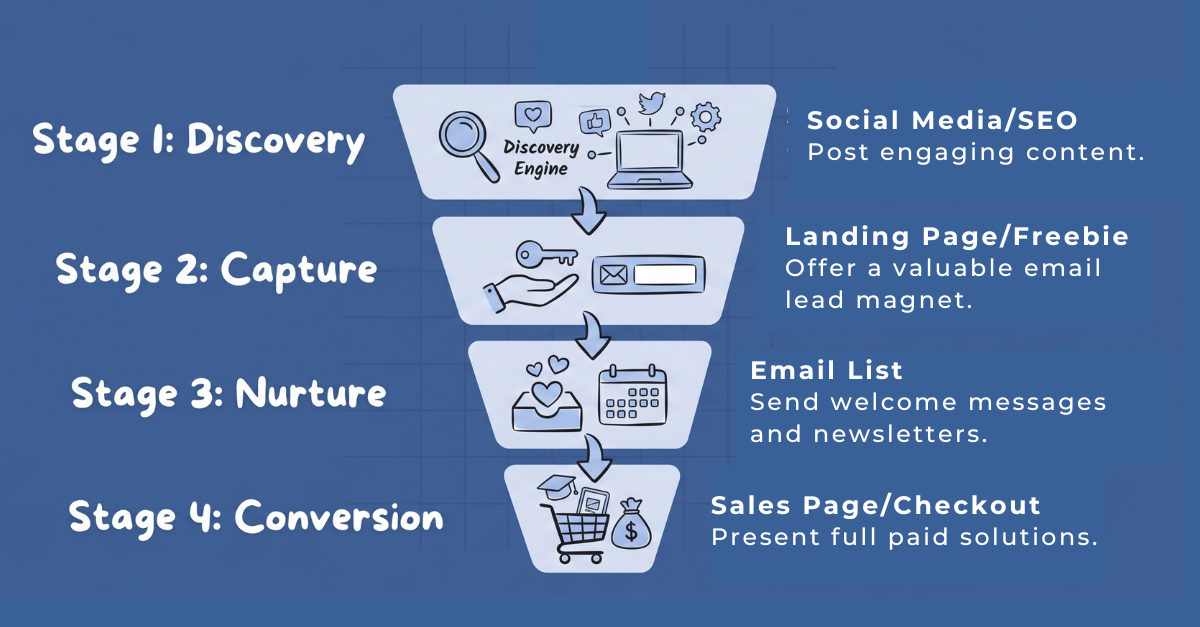
Today we’re breaking down the digital marketing funnel that spreads out your business across avenues and builds a self-sustaining model.
Phase 1: Top of Funnel – TOFU
The funnel begins where your audience already hangs out: social media (LinkedIn, Instagram, TikTok) and search engines (Google SEO).
At this stage, people aren’t looking to buy anything; they’re Googling how to solve their problem or doomscrolling after a long day at work.
They’re looking for a quick fix or dopamine hit.
That’s why your goal here isn’t to pitch a product—if you come on too strong before the audience has been primed to buy, they’ll scroll right past to watch a cute cat video instead.
Social media works best when you capture interest and prove your authority.
Most businesses make the mistake of leaving their audience on social media. But likes and comments don’t pay the bills, and you don’t own those platforms. You need a strategic bridge that guides them off the app and into your ecosystem.
Phase 2: Middle of Funnel – MOFU
How do you get someone to leave a distracting social feed?
You offer them an irresistible offer.
The middle of the funnel is where your Lead Magnet or free offer comes into play.
A common strategy goes as follows: You invite your audience to trade their email address for a high-value resource.
This could be:
- An interactive tracker or calculator
- A comprehensive guide or checklist
- A resource library or templates
Some great examples include Erin McGoff’s (AdviceWithErin) salary negotiation guide and Tori Dunlap’s (Her First 100K) personalized money plan quiz.
Whatever you offer as your lead magnet, it needs to solve a small, immediate problem for your target audience right away—making it irresistible and worth inputting their email.
Phase 3: Nurture Stage
Once they opt in, the customer is subscribed to your owned email list.
Your email inbox is where the real work happens because you have direct, unfiltered communication with your audience for the first time.
No social media algorithm to rely on, no platform rules to obey. Just you and a direct email to your audience.
But before you ask for a sale, you have to nurture the relationship.
Think of it like dating. You wouldn’t jump into marriage after just a first date, the same way your audience won’t spend large sums of money on your product after seeing one email.
To nurture your audience, use a strategic mix of two delivery systems:
- Automated Welcome Sequences: Every time a new subscriber joins your email list, they’ll automatically receive your welcome sequence, a series of automated emails that act as a one-time brand introduction to build long-term authority and trust and share your unique backstory. You set it once, edit it thoroughly, and let it run.
- Recurring Newsletters: Send newsletters on a regular basis to get in front of your audience. Newsletters foster consistent reading habits and keep your business top-of-mind by consistently delivering insights and breaking down complex problems.
With this combo, your audience will gradually get to know you (and your offer) better and see you as a trusted authority.
Want more tips on how to connect with your audience? Check out my top 5 methods for authentic connection.
Phase 4: Bottom of Funnel – BOFU
By the time your subscriber reaches the bottom of the funnel, they aren’t a cold lead anymore.
They know your story, they’ve experienced the value of your free tools, and they view you as an expert.
And now that they trust you, they are primed for the buying stage.
Because you’ve spent the time establishing a stronger connection, pitching your paid product, course, or digital services feels like a natural next step rather than an awkward, aggressive sales pitch (we’ve all been there).
You are simply offering the premium solution to the problems you’ve already been helping them solve.
The Complete Funnel at a Glance
Here is exactly how your digital marketing funnel flows from top to bottom:
1. Discovery: Post engaging content on social media to act as a discovery engine.
2. Capture: Offer an irresistible lead magnet in exchange for an email.
3. Nurture: Send automated welcome sequences and recurring newsletters vi email.
4. Conversion: Present your paid digital products, courses, or services.
You now have the strategic roadmap to transform rented social media attention into a high-yielding, owned marketing asset.
But frameworks without execution tools remain entirely theoretical.

Set up the systems now and truly own your business.
Future you will thank you.